Showing posts with label globalization. Show all posts

Monday, September 03, 2007

My New Hobby: FedEx Tracking

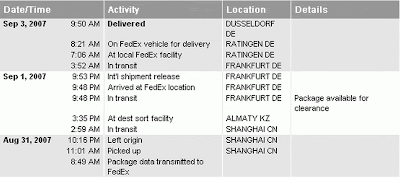
Ah, international logistics. What fun. Being the cold-hearted neoliberal capitalist that I am, I recently discovered a new free time activity: FedEx Tracking! It looks like this:

Almaty! Just imagine! So, I try to generate as much tracking numbers as possible in order to insert the numbers and track the shipments! It's a little bit expensive, though :-/

To my horror, I learned today that FedEx does not deliver within Germany. Argh! In my panic, I chose DHL instead. After only five minutes in the queue, I was told that I have to buy an envelope first! But not at the DHL counter - noooo! Another 20 minutes spent in line at the normal post office counter. And back to the queue at the DHL counter. I'll try TNT next time. Then again, as I just checked the TNT web site for a little test, the system told me that "destination and zip code don't match!" So, you wanna tell me that I don't know my own zip code, or what? That's certainly not a good start...

Lessons learned today:

1.) FedEx does not do domestic Germany.

2.) The term "free-of-charge envelope" is totally unknown to DHL.

Friday, January 12, 2007

The U.S. and Europe - Globalization meets cheese standards

Thomas P.M. Barnett, reviewing Roger Cohen's review of Überpower, has this to say:

Europe keeps expecting America to 'come home' and it just ain't gonna happen. We're living in the vast rule-set reset that is globalization's advance around the planet. Europe and Japan, the classic West other than America, wants largely to sit this process out, instead arguing over cheese standards and ag subsidies and UN Security Council resolutions.


(a 2006 draft leftover)

Is China going to dominate the 21st century?

From "Learning to Keep Learning" By THOMAS L. FRIEDMAN, The New York Times, December 13, 2006:

(...)

Sorry, but I am not ready to cede the 21st century to China yet.

No question, China has been able to command an impressive effort to end illiteracy, greatly increasing its number of high school grads and new universities. But I still believe it is very hard to produce a culture of innovation in a country that censors Google — which for me is a proxy for curtailing people’s ability to imagine and try anything they want. You can command K-12 education. But you can’t command innovation. Rigor and competence, without freedom, will take China only so far. China will have to find a way to loosen up, without losing control, if it wants to be a truly innovative nation.

(...)

Why should any employer anywhere in the world pay Americans to do highly skilled work — if other people, just as well educated, are available in less developed countries for half our wages?

If we can’t answer this question, in an age when more and more routine work can be digitized, automated or offshored, including white-collar work, “it is hard to see how, over time, we are going to be able to maintain our standard of living,” says Marc Tucker, who heads the National Center on Education and the Economy.

(...)

Tomorrow, Mr. Tucker’s organization is coming out with a report titled “Tough Choices or Tough Times,” which proposes a radical overhaul of the U.S. education system, with one goal in mind: producing more workers — from the U.P.S. driver to the software engineer — who can think creatively.

(...)