Showing posts with label germany. Show all posts

Monday, January 07, 2008

The 2008 Election - An Answer to Mad Minerva

If you ask me, there are two democracies in the world truely deserving this label: America and Switzerland. Two completely different approaches of trying to get the people's will represented - but both superior to any other political system I know.

Are Swiss and Americans happy with their political system? No, they are not. If you have ever visited a Swiss blog headquarter of political punditry, you know what I'm refering to. Or take this NYT opener, for example:
Even by the low standards of presidential campaigns, the issue of immigration has been badly served in the 2008 race.
Low standards? Dear Sir/Madam, hiding behind the "Editorial" curtain, have you ever happen to follow an election campaign in any given European country? My suggestion: Do it! And recalibrate your expectations.

Or take the undisputed Queen of Conservative Middle-Of-The-Roadism: (any objections, Brian? ;-))
it seems vaguely unjust that a tiny state like Iowa has such a huge impact on the entire presidential election process of 2008. Less than 1 million Iowans will actually "vote" in the caucuses. I also doubt that Iowa is an accurate representation of any piece of America as a whole other than Iowa.
Read this and think again, MM (emphasis mine):
What an absurd way to choose a president, sneer many non-Americans, perhaps forgetting their own arrangements (the coronation of Gordon Brown as Labour leader and prime minister, without a single vote, springs to mind).
(Nota bene: the coronation of Gordon Brown wasn't only without a single vote, but through a single vote: Tony Blair's. In Germany, it wouldn't have been different.) Read the whole thing: In praise of the primaries, The Economist)

I'm absolutely thrilled by the American 2008 election campaign. Today, I got an email by the aforementioned Mad Minerva which starts as follows (link to her related blog post added):
I'm glad you're enjoying the start of the 2008 American political marathon! You say it's "thrilling." A British commentator has said so, too. Is the American race's atmosphere so different from European elections?
Girl, I don't want to sound mean, but ... are you serious?

The short answer is: YES.

The more elaborated answer? Well,... where to start? Coming to think of it, it's hard to find even similarities between the German way to elect a Bundeskanzler (let's restrain it to Germany) and the American way to choose a new POTUS.

Let's begin with a statement of one German correspondent in America, aired on German public radio Deutschlandfunk the other day (my emphasis, again):
The election campaign is lasting for twelve months now. The first hopefuls trudged through the snow of Iowa and New Hampshire in January 2007. Each candidate had to organize and finance his campaign by himself. No other nation expects such exertions of their top politicians.
(Full German original is here: Das Signal von Iowa. Von Klaus Jürgen Haller)

This statement gives some useful hints. An American would probably say: "Yeah, self-financed and self-organized. Are ya tellin' me there are other possibilities to run a campaign???"

Well, um, yes, there are. In Germany, the campaigns are financed and organized by the political parties. And where do those get the funding from? Guess what, from their members, from donations - and from the state. And where does the state get the money from to fund the parties' campaigns? Guess what - from the taxpayers. It's quite obvious that this influences the atmosphere of an election campaign, no?

Next, the scrutiny depth. In Germany, the candidates are chosen by the parties, that is to say by the party establishment. And in most cases, it comes down to a self-nomination by the party leaders. Now, self-nomination means: no quality check, no scrutiny.

And in America? Every newspaper, every TV station (as local as it might be), every other media outlet (not to mention bloggers!) is X-raying each candidate (plus his loved ones, and ex-loved ones, and business partners, and ex-business partners and so on) over and over again. It turns out that you, the candidate, pilfered someone's lunch snack when you were a third-grader? Gosh! That's "mayday-mayday!" for your staff! Your second cousin faked his tax declaration? OMG, CNN breaking news! Wolf Blitzer live, interviewing the second cousin's ex-wife!

Admittingly, the media hype, fuelled by mean bloggers, has taken this scrutiny issue a bit too far lately, but I still prefer the American way of collecting some information (including medical record and personal financial situation) about the candidates before voting for them to the German approach, where this is left mainly to the candidates' party and some MSM gatekeepers.

What else is it that makes the atmosphere of an American election campaign? The mere number of hopefuls - especially this time! In Germany, it usually boils down to two well-known candidates. (If there would be three, it would be considered a political earthquake.) Not to forget the campaign methods, like TV debates, NEW!--->youtube debates<---NEW!, door-to-door-campaigning, fundraising dinners, speeches before huge audiences, classroom chit-chats, internet chats ... you name it. In Germany, we have market place speeches (only one candidate, no debate), some TV debates with party officials (including the smaller parties), two important TV debates (if anything) and some internet embarrassments - and that's about it.

I'm feeling like I could go on for hours on that one. Perhaps, you already got my point.

Monday, September 03, 2007

My New Hobby: FedEx Tracking

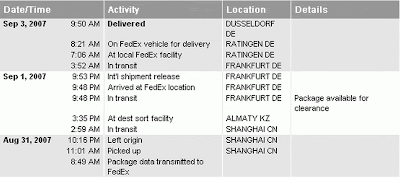
Ah, international logistics. What fun. Being the cold-hearted neoliberal capitalist that I am, I recently discovered a new free time activity: FedEx Tracking! It looks like this:

Almaty! Just imagine! So, I try to generate as much tracking numbers as possible in order to insert the numbers and track the shipments! It's a little bit expensive, though :-/

To my horror, I learned today that FedEx does not deliver within Germany. Argh! In my panic, I chose DHL instead. After only five minutes in the queue, I was told that I have to buy an envelope first! But not at the DHL counter - noooo! Another 20 minutes spent in line at the normal post office counter. And back to the queue at the DHL counter. I'll try TNT next time. Then again, as I just checked the TNT web site for a little test, the system told me that "destination and zip code don't match!" So, you wanna tell me that I don't know my own zip code, or what? That's certainly not a good start...

Lessons learned today:

1.) FedEx does not do domestic Germany.

2.) The term "free-of-charge envelope" is totally unknown to DHL.

Saturday, August 25, 2007

Intelligenzbestie March Tian Boedihardjo

Mad Minerva has the story about nine-year-old March Tian Boedihardjo, the youngest ever student to enrol in a university in Hong Kong. You go, boy! Well done! And all the best for your future.

In the German news, they used the term Intelligenzbestie to describe March. The English term is "brainiac", but the word Intelligenzbestie, literally Intelligence beast, is so telling. An intelligent person is a problem and a threat to society, as is a beast.

Btw, the press conference with March and his father had a very nice quote of the latter (my emphasis):

"I will advise parents in Hong Kong there's no need to know the IQ of your children. Just try to do your best to nurture them and give them space to develop," Tony Boedihardjo said.
That's it. Nurture and space. Education is easy.

Friday, January 12, 2007

Radio Play About Bix Beiderbecke

Lots of cats tried to play like Bix; ain't none of them play like him yet.

Yesterday, there was an radio play aired on German radio station Deutschlandfunk, called
Leben und Tod des Kornettisten Bix Beiderbecke aus Nordamerika (Life and Death of the cornett player Bix Beiderbecke from North America; link is in German), by Ror Wolf (link in German) from 1986, which was awarded with the Hörspielpreis der Kriegsblinden (radio play prize of the "Federation of the German War-Blinded"; link in German) the following year; which is the most important and prestigious prize for radio plays in Germany.

This radio play about Bix Beiderbecke brought one thing back into my mind as clear as possible, namely the importance of the internet for my little life. Because it was the third time that I listened to the play - first time was in 1986, second was in 2003 (I guess, because that was the 1ooth anniversary of Bix' birth) - and both times, I was left to my own devices concerning further information about Bix. Even in 2003, I didn't have the possibilities I have now, and in 1986, there was literally nothing I could do but wait until I happen to enter a record shop for the next time. But today, I just type in the name at wikipedia and youtube - and here we go:

Here you can find some Audio tapes of interviews conducted with people who knew Bix Beiderbecke. You can find "Bix Beiderbecke & His Rhythm Jugglers - Davenport Blues (January 26, 1925)" as mp3, too.

And finally, three videos from youtube. It's so fantastic to have all these sources, right? (Plus, I have a copy of the radio play in ogg format now!)

A tribute:


Wake Up Bix:


The Jean Goldkette Orchestra in 1926:

Friday, September 22, 2006

"...and will come again if ever needed" - Remembering JFK in Berlin

Last week, I joined a group of about 50 people for a four-days-tour to Berlin. The trip was organized by the Press and Information Office of the Federal Government (Federal Press Office) to show us citizens and taxpayers how the politicians are using our money. It was an interesting journey which most informative parts were about German history. The first site we paid a visit to was Checkpoint Charlie, and among other places, we also visited the Berlin-Hohenschönhausen Memorial, the Marienfelde Refugee Center Museum - and the Rathaus Schöneberg, the location where then US President John F. Kennedy held his famous speech in 1963, proclaiming "Ich bin ein Berliner".

A few years ago, I worked near the Rathaus Schöneberg for almost a year, and visiting the building used to be an everyday business to me. I knew about the Kennedy speech including the famous quote, but I didn't really pay attention to back then. Therefore, it was quite a strange experience to enter the building as part of a guided tour. We even entered the balcony, from which we had a similiar view as JFK on June 26, 1963, when he delivered his speech from a platform some feet below. The guide told us about the historical context of the speech and how important it was that JFK was accompanied by General Lucius D. Clay, the "father" of the Berlin Airlift. After I've watched the video of the speech, I think that the opening remark

And I am proud (...) to come here in the company of my fellow American, General Clay, who has been in this city during its great moments of crisis and will come again if ever needed.


was the most important part of the whole speech, at least for the audience at that time, giving them exactly the boost of confidence and reassurance to be under U.S. protection they needed.

JFK's interpreter, Robert H. Lochner, remembers:

Clay, whose interpreter I had been, had recommended me to Kennedy, and I interpreted for the president during the whole trip to Germany. The reception Kennedy received in Cologne, Bonn and Frankfurt had already been enthusiastic but paled against the reception by the West Berliners.

As we walked up the stairs to the city hall in West Berlin for Kennedy's major speech, he called me over and asked me to write on a piece of paper in German, "I am a Berliner." I did, and when we got to West Berlin Mayor Willy Brandt's office, while the hundreds of thousands of Berliners were cheering outside, Kennedy practiced it with me a few times before going out on the balcony for his historic speech.


The most powerful part of the speech, of course, is the following, ending with the second German phrase used by JFK, which even made it to youtube, as you can see below:

There are many people in the world who really don't understand, or say they don't, what is the great issue between the free world and the Communist world. Let them come to Berlin. There are some who say that communism is the wave of the future. Let them come to Berlin. And there are some who say in Europe and elsewhere we can work with the Communists. Let them come to Berlin.


Robert H. Lochner, again:

To Kennedy's political adviser, McGeorge Bundy, if nobody else, it was immediately apparent that making the famous "I am a Berliner" pledge in German gave it considerable additional force. Some historians argue it wouldn't have gone around the world and into history the way it did if he had said it in English. When, after the speech, we again briefly assembled in Brandt's office, I stayed close to the president in case he should talk to any Germans. I could not help overhearing Bundy saying to Kennedy, "I think that went a little too far."


I hear some, if not many Americans complaining that Germany seems to have forgotten about German-American post-war history, especially about the airlift and the contribution of John F. Kennedy and his successors as presidents of the United States. It might well be that we don't remember this history as it would be appropriate - but it is not forgotten. To illustrate my point, I want to close with a quote from a Deutsche Welle article back from 2003, dealing with the 40th anniversary of the "Ich bin ein Berliner" speech:

Today, 40 years later, Kennedy's legacy lives on in Germany's collective memory - for example in school books, documentaries about the cold war and in an exhibition at the German National Museum of Contemporary History in Bonn. There, the most famous excerpt of Kennedy's speech is displayed on a television monitor, and there is a copy of the piece of paper John F. Kennedy held in his hand when delivering his speech, complete with the lines "Ich bin ein Berliner" and "Let them come to Berlin" scrawled on it in his own hand-writing.

Herman Schäfer, a custodian at the museum, says the document still elicits a deep response today.

"The reaction of our visitors is very enthusiastic, still enthusiastic, even though this 40 years ago. Everybody - be it young or old people - have in mind that this is a quotation from John F. Kennedy. So they hear this quotation and then the look into the glass case and see with even more surprise that there is this little document with the phonetic transcription of John F. Kennedy. So there is still this enthusiasm about this quotation that (puts) so much emphasis on the German-American friendship during the 1960s."


Submitted to Carnival of German-American Relations

Update August 16, 2009: Since the originally embedded youtube video was removed, I replaced it with a similar, albeit longer, video.

__________